
Trending
This story is from March 8, 2012
For women, of women, by women
As a writer, producer and director, Sumitra Bhave has made films like 'Nital,' 'Ek Cup Chya' and 'Gho Mala Asa Hava.' Her directorial approach avoids stereotypes, conventional gender biases and societal cliches.
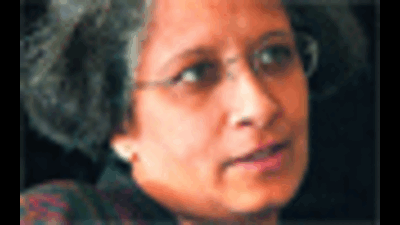
As a writer, producer and director, Sumitra Bhave has made films like 'Nital,' 'Ek Cup Chya' and 'Gho Mala Asa Hava.' Her directorial approach avoids stereotypes, conventional gender biases and societal cliches.
As a writer, producer and director, Sumitra Bhave has made films like 'Nital,' 'Ek Cup Chya' and 'Gho Mala Asa Hava.' Her directorial approach avoids stereotypes, conventional gender biases and societal cliches.

The first film is about a leukoderma-affected woman who marries a doctor; the second is about the RTI Act from a woman's perspective, while the third is about a comedy about a village girl looking for a suitable match.
However, exhibiting such films is a hurdle. "I pen and make my films with a different value system. There are subtle undertones that project the woman's point of view. I choose not to show the conventional male perspective on feminine beauty and feminist issues. Such films resonate with a thinking audience. However, I have had to struggle to get my films through to the audiences because of middlemen like distributors and exhibitors. They need convincing," Bhave said.
Her films have won accolades at national and international festivals. "If my films are being appreciated at film festivals, they must easily reach my own audience," she said. Her cast and crew, like co-director Sunil Sukhtankar, share her sensitivity
Bhave said there is an upside. "Young men and women are entering film-making. Many are sensitive towards women's issues. We can hope to see a better handling and dilution of gender-bias in cinema. However, the goal is to go beyond feminism for a humanistic approach to film-making," Bhave said.
Gender stereotypes, cliches and conventional definitions of female beauty and a woman's place in society, largely prevail in Indian cinema, said film expert Shyamala Vanarase.
"Importantly, a woman-centric film doesn't necessarily mean it's a feministic film. A film like 'Mee Sindhutai Sapkal,' a biopic on the social activist, tells her story from a male perspective. A woman's assertion is in the choices she makes should be projected in cinema," Vanarase added.
Scriptwriter-production designer Sandhya Gokhale has consciously penned strong female characters as protagonists in Amol Palekar-directed movies like 'Anaahat' and 'Paheli,'. "All my films have self-reliant, self-sufficient and assertive women protagonists who accept and address their vulnerability and learn to overcome them. They look at themselves as humans first," Gokhale said.
Actor Sonali Bendre's character in 'Anaahat' makes her own choice in a patriarchal, political set-up, while Rani Mukerji in 'Paheli' takes responsibility for the choice of her man.
"We need many more bold, strong, assertive and decisive female characters in our movies so that they can become role models for women in our society. Women in our cinema are mostly regressive and conventional and they manage themselves within a patriarchal set-up. We haven't dealt with issues that emancipate women," she added.
End of Article
FOLLOW US ON SOCIAL MEDIA










Hot Picks
TOP TRENDING
Trending Stories
In City
Entire Website
- 7 Must-Watch Films to Inspire Students
- Florida woman who sold all her possessions for a 3-year luxury cruise banned for WhatsApp messages
- Animal fat in Tirupati laddu: Centre intervenes, temple trust blacklists supplier - Top developments
- Indian Embassy official found dead at Washington DC office under mysterious circumstances
- Rohit Sharma gets angry at team-mate: 'Soye hue hain sab log'
- PM Modi on 3-day US visit for Quad summit: Key agendas, full schedule
- 10 Daily Habits for Students to Keep Their Minds Young and Sharp
- 'When temples are being attacked ... ': Andhra deputy CM Pawan Kalyan on Tirupati laddu row
- NIA conduct raids at several locations across Punjab in terror-conspiracy case linked to Gurpatwant Singh Pannun
- To challenge Ola and Uber, Chennai auto drivers rebuild ride-booking app after crippling hack
- Expanding Air India's punctuality woes leave flyers frustrated
- Kejriwal's big claim: PM Modi conspired to prove me dishonest
- How ultra-bhakts went from BJP’s biggest asset to its biggest problem
- 'Naidu a pathological liar': Jagan Reddy writes to PM on laddu row
- UP police books Class 6 student for rioting and attempt to murder
- 'I had to beg for help': Manish Sisodia on financial struggles amid corruption case
- Billionaire fugitive spotted in Belgium. Can India get him this time?
- How India prices of iPhone 16 compare with US, Canada, Singapore, Dubai
- Netflix under scrutiny over visa, tax, and racial discrimination accusations
- Israel PM says will 'not tolerate' attacks after rockets from Lebanon

Popular Categories
Hot on the Web
Top Trends
IND vs BAN Live ScoreArvind Kejriwal's Janta Ki AdalatRishabh PantRohit SharmaShubhman GillUGC NET Result 2024CBSE NotificationTirupati Laddu RowIsraeli Strikes on HezbollahRandy Orton WifeIsrael Hezbollah WarIND vs BAN Highlights Days 3Tirupati PrasadamEY Pune EmployeeSean DiddySandip GhoshLive Cricket Score
Trending Topics
Daughter's Day WishesDaughter's Day 2024 WishesAbdu RozikMukesh KhannaJayamSana Khan HusbandTirupati Laddoo ControversyGOAT CollectionVaazha OTT ReviewKozhipannai Chelladurai ReviewCheetahsKangana RanautAditi Rao HydariDalljiet KaurHoliday DestinationVikas SethiBest Selling Earbuds Under 1000Apple iPhone 16 ProVirat KohliWordle Answer
Living and entertainment
Latest News
Delhi CM’s statement highlights loyalty dilemma in Indian partiesShivani Sharma talks about the rapid growth of regionalWhen Salim Khan talked about Big B's low phase'No bunker needed in J&K': Amit Shah says nobody in Pakistan has guts to open fireHrithik Roshan SPOTTED filming intense action sequences for 'WAR 2' in Italy - WATCH"Her artistic journey...": Kamal Haasan pens emotional tribute to veteran actress Kaviyoor PonnammaUAE to celebrate 94th Saudi National DayKarnataka CM Siddaramaiah warns of legal action against those spreading fake newsMakers of ‘Get Set Baby’ drop a new poster on Unni Mukundan’s birthdayLucky numbers for September 22 to September 28: Your weekly fortunate number revealedUP: Muslim 'healer' arrested for sexually assaulting teen girlThe truth about sugar substitutes: Safe alternative or hidden health risk?Malaysian police arrest hundreds in child abuse probeAryan Khan or dad Shah Rukh Khan, who wore this lather jacket better?Why Rahul Gandhi is off the mark when it comes to SikhsNavya Nanda attends event in Mumbai, poses with Karisma Kapoor and Ananya PandayNo rain likely for three days, temperature to go up; AQI turns worse in DelhiSatyapal Malik says Maharashtra polls ‘last nail in BJP’s coffin’, backs MVA
Copyright © 2024 Bennett, Coleman & Co. Ltd. All rights reserved. For reprint rights: Times Syndication Service